Consulting with AI
Most “AI tools” for consultants and knowledge workers don’t survive contact with real work. They handle clean, short prompts, then fall apart when you upload an actual tender pack, a messy draft report or a research instrument written under time pressure.
The toolkit below is built for those real inputs. Each tool is a complete workflow: a detailed system prompt, paired with supporting reference files (rules, schemas, libraries) that constrain the model’s behaviour and make the output structure repeatable. You can run them on Claude, ChatGPT, or any major language model that supports file uploads and longer context (I use Claude for this type of work).
This toolkit is for people who want AI support that holds up in professional settings: consultants, researchers, analysts, evaluators, and anyone who has to produce outputs that need to be defensible. I built these for my own work and use them weekly.
These tools don’t replace judgement. They standardise time-consuming and complex activities that are easy to do inconsistently and expensive to redo. You should use these prompts like an analyst with a checklist. They will be fast and thorough, but they still need oversight. You should always treat outputs as a first-pass brief, and then make the judgement calls yourself.
What’s in The Toolkit
Each prompt is designed to work from your documents and flag uncertainty rather than filling gaps with guesses. Let’s have a look:
📑 Tender Slayer
Tender Slayer extracts the key information from an ITT or RFP pack into a structured scoping brief: deadlines, submission mechanics, compliance requirements, deliverables, evaluation criteria and weightings, commercial constraints, and disqualification risks.
It reads documents in priority order, surfaces contradictions between documents as red flags, and generates clarification questions to take back to the buyer. Where the tender documents allow it, it grounds critical claims with page and section references so you can verify quickly.
☑️ Report QA
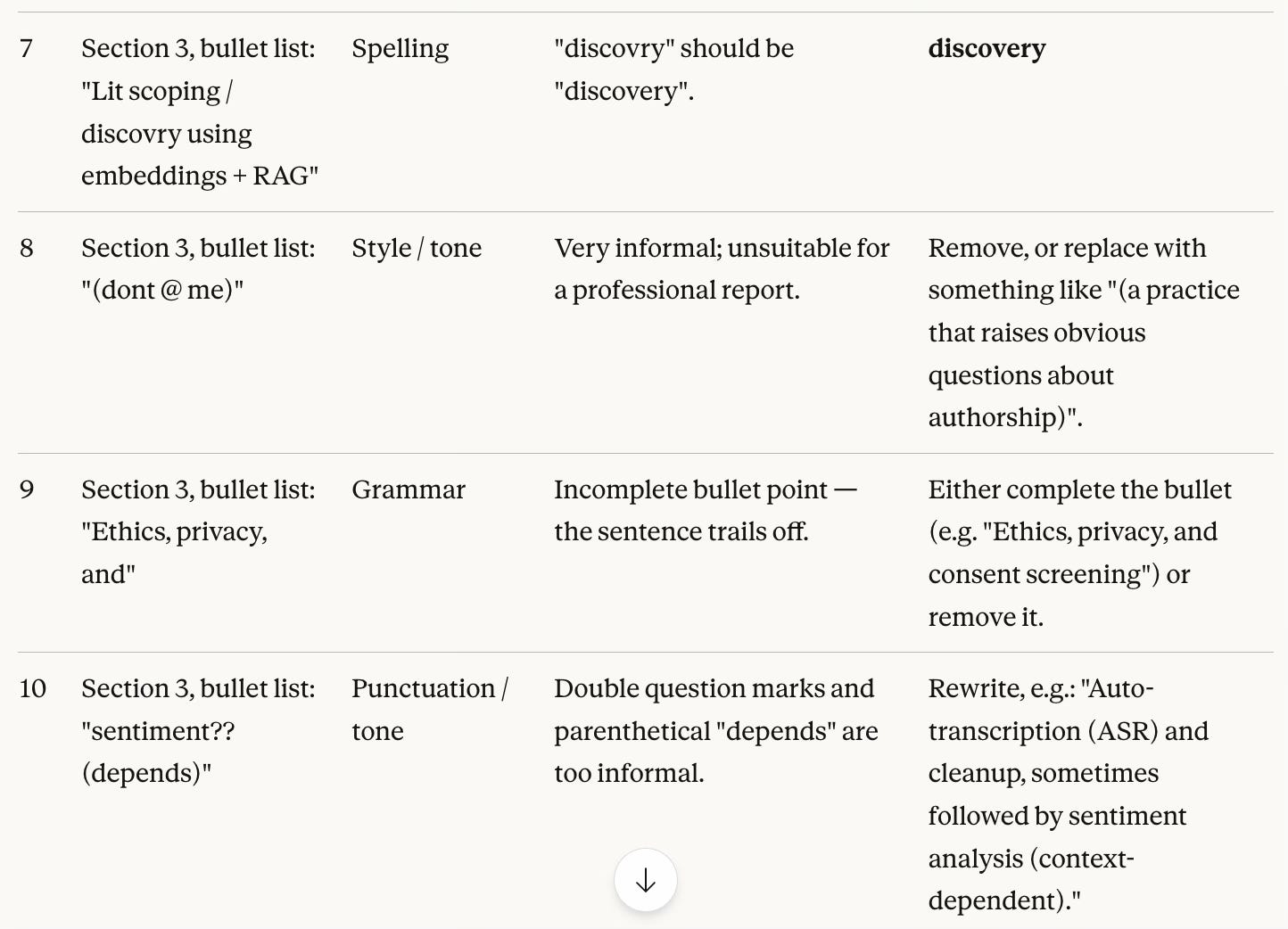
Report QA checks a report draft against an explicit and detailed ruleset: spelling and grammar, punctuation and capitalisation, number formatting, list consistency, term usage, cross-references, and internal logic.
The output is a structured issue log (location, issue type, explanation, minimal correction), preceded by a short summary of recurring patterns. It focuses on the smallest edit that fixes the problem without flattening your voice or rewriting content.
🙋🏽 The Art of Fixing Questions
This tool reviews surveys, interview guides, focus group schedules, and workshop prompts. It flags issues with neutrality, clarity, response options, scale design, flow, and fitness for purpose.
It catches a range of problems that seriously damage data quality: double-barrelled wording, leading questions, missing timeframes, unclear constructs, response options that don’t cover the full range, and topic jumps that confuse participants. It then proposes fixes and produces a minimally edited improved instrument you can copy into your tooling.
📖 Storytelling Pro
Upload notes, reports, transcripts, case studies, or data, and Storytelling Pro generates several distinct narrative structures, each built from a curated library of 100 storytelling tactics.
Each option includes a name, intended effect, a beat outline, and the specific tactics used, with a rationale for why they fit your material. If your source doesn’t contain something required for the structure, it flags a placeholder rather than filling gaps with guesses.
🗂️ Thematic Coder (Claude Code)
Upload qualitative information (transcripts, documents, and more), and Thematic Coder will provide an in-depth analysis of themes and sub-themes by leveraging Claude Code.
This is a powerful implementation of thematic coding, based on an operator-subagent architecture to reliably analyse large amounts of information in a way that you can review and audit after. This frees up lots of time, which you can then use on the most value-adding part of your work - synthesis and storytelling.
Try it first
If you want to see whether this approach fits your work, start with Report QA, which I’m making available for free (prompt + rules file), alongside a worked example using a dummy report with errors.
Free Report QA pack (Google Drive): https://drive.google.com/drive/folders/1mPnfyXvlm_TXUyJFyTzs1JTEn5B1C_1P?usp=sharing
Worked example (Claude share): https://claude.ai/share/4696abb7-5745-4759-9846-c37a4f0ad54d
👉🏼 If you found this useful, subscribing unlocks the remaining three workflows (Tender Slayer, The Art of Fixing Questions and Storytelling Pro) including their supporting reference files.