
Words Build Workplaces
A manifesto for behaviour-first leadership

If Medium is your go-to reading spot, you can catch this post there too! Just click here.
We don’t manage in a vacuum; we manage in language. The words we use become the water people swim in - subtle cues about safety, status and what “good” looks like.
A handful of phrases - “imposter syndrome,” “culture fit,” “single throat to choke” - sound tidy and professional in the corporate world. But each one quietly shrinks your team. “Imposter syndrome” tells individuals they’re the problem instead of fixing norms and sponsorship. “Culture fit” filters out difference and calls it quality. “Single throat to choke” designs for blame, not collaboration.
This piece is a working manifesto: what to retire, what to say instead, and how to hardwire better language into our organisations.
Why The Bad Words Stick
Unhelpful words stick because:
They flow - short, familiar and easy to reach for under pressure.
They’re vague - they let us sound decisive without naming a concrete behaviour anyone could dispute.
They’re status-preserving - labels justify decisions (pay, promotion, exits) with less scrutiny.
They’re systemised - baked into apps, software and templates.
Yes, we’re responsible for the words we choose. But let’s be honest: most of us were trained by the broader leadership culture around us. It’s like growing up on classic Disney - boys as brave knights, girls as helpless princesses. Of course that shapes how you see gender later. Disney has since got a lot better at representation and gender roles. But corporate culture hasn’t really updated its language.
So… I think we need to change what we teach. To help with that, I’ve put together a manifesto (for lack of a better word). I’d love to hear your thoughts on it.
A Manifesto for Behaviour-First Leadership
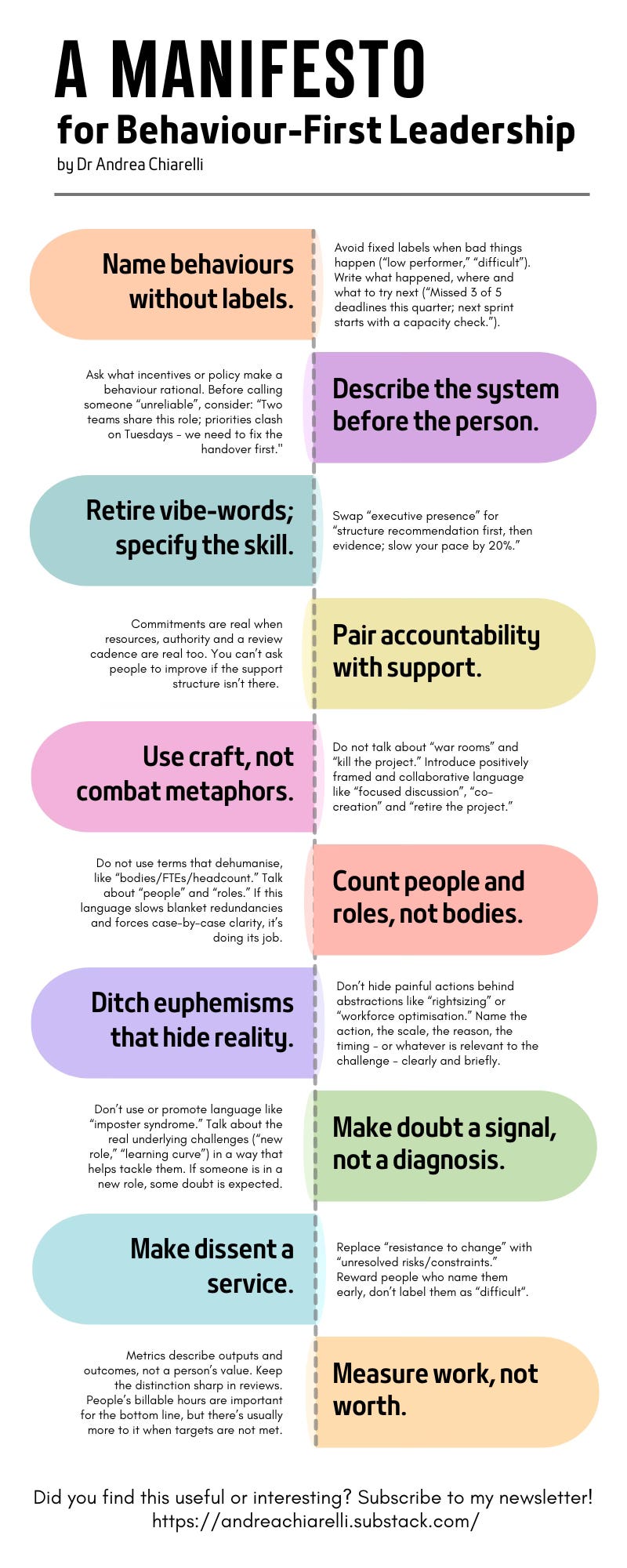
Name behaviours without labels.
Avoid fixed labels when bad things happen (“low performer,” “difficult”). Write what happened, where and what to try next (“Missed 3 of 5 deadlines this quarter; next sprint starts with a capacity check.”).
Describe the system before the person.
Ask what incentives or policy make a behaviour rational. Before calling someone “unreliable”, consider: “Two teams share this role; priorities clash on Tuesdays - we need to fix the handover first."
Retire vibe-words; specify the skill.
Swap “executive presence” for “structure recommendation first, then evidence; slow your pace by 20%.”
Pair accountability with support.
Commitments are real when resources, authority and a review cadence are real too. You can’t ask people to improve if the support structure isn’t there. Try “Take this forward with a 2-hour-per-week allowance, decision rights A/B and fortnightly review.“
Use craft, not combat metaphors.
Do not talk about “war rooms” and “kill the project.” Introduce positively framed and collaborative language like “focused discussion”, “co-creation” and “retire the project.”
Count people and roles, not bodies.
Do not use terms that dehumanise, like “bodies/FTEs/headcount.” Talk about “people” and “roles.” If this language slows blanket redundancies and forces case-by-case clarity, it’s doing its job.
Ditch euphemisms that hide reality.
Don’t hide painful actions behind abstractions like “rightsizing” or “workforce optimisation.” Name the action, the scale, the reason, the timing - or whatever is relevant to the challenge - clearly and briefly.
Make doubt a signal, not a diagnosis.
Don’t use or promote language like “imposter syndrome.” Talk about the real underlying challenges (“new role,” “learning curve”) in a way that helps tackle them. If someone is in a new role, some doubt is expected.
Make dissent a service.
Replace “resistance to change” with “unresolved risks/constraints.” Reward people who name them early, don’t label them as “difficult“.
Measure work, not worth.
Metrics describe outputs and outcomes, not a person’s value. Keep the distinction sharp in reviews. People’s billable hours are important for the bottom line, but there’s usually more to it when targets are not met.
To be clear, this isn’t word-policing. This is an open invitation to check ourselves so we can have better, more productive relationships at work. I am writing this for myself in the first place, to try and make sure unhelpful language doesn’t slip into my conversations.
A Helpful Formula
When you need to describe a situation cleanly and decide what to do next, you can use this formula:
Behaviour + Context + Impact + Next steps
Name what happened; where/under what constraints; why it matters; and what you’ll try next. This works because it replaces labels with observable facts, surfaces system causes and moves the conversation from judgement to action.
Here’s how you can write one:
Start with the observable behaviour (no adjectives, no mind-reading).
Add the context (competing goals, constraints, timing).
State the impact (on customers, cost, quality, time).
Commit to concrete next steps (owner + deadlines).
A quick example:
Behaviour: Missed 3 of 5 sprint deadlines.
Context: Two teams booked the same person on overlapping priorities.
Impact: Release slipped by 48 hours and rework increased.
Next steps: Rebalance capacity each Monday; product lead to confirm priorities by 10:00; review in two weeks.
What To Do Next
First, let me know what you think of the manifesto - I’d be really interested in learning how others have internalised today’s leadership jargon. Then, it’s all about taking small, measured steps and bringing the rest of your organisation on a journey with you.
We don’t have to wait for HR or a rebrand to fix things. We can start small, make our changes visible and our team will follow. When we replace labels with behaviours - and pair accountability with support - we don’t just “sound nicer.” We genuinely do make better decisions, faster and with fewer casualties.
Here’s a micro-plan for next Monday:
→ Pick 5 phrases to retire (e.g., culture fit, executive presence, resistance to change, war room, rightsizing) and their replacements. Write them on one page.
→ Patch templates: add a line in reviews and hiring scorecards for Behaviour + Context + Impact + Next steps.
→ Give your team a go-to reset question: “Can we put that in behaviour terms?”
→ Do one live swap: Rewrite a current job ad or performance note; or update an email using the new language.
That’s how movements start - one better sentence at a time!
I'm Andrea, a management consultant with over a decade of experience across industry and academia. I work with commercial, non-profit, academic and government organisations worldwide, helping them capture meaningful insights through mixed methods research.
I write about practical frameworks to help you discover what others miss. My main goal is to translate complex concepts into techniques that readers can use immediately.
Corporate jargon indeed! I'm certain I've heard all those phrases; they are all familiar and in both the private and public realms. Likewise, I've not found HR departments to be 'leaders' in this area. They tend to Policy rules rather than helpful discourse. I've actually found it useful to be communicating with folks where english is a second language. This then demands a more straight forward dialogue and frequently with examples to ensure a conversation is understood.
Your articles were recommended to me. I'm pleased I subscribed.
You bring up a very interesting topic.
On the one hand, words shape behaviors and beliefs; on the other, they are shortcuts to convey higher-level concept.
“Executive presence” is not an empty box, bur rather conveys the idea of a strong character, eye contact, measured tone, courage, strong body posture.
If I read you correctly, your diagnoses of the underlying problem is that we have learned to use these “broad words” mechanically (aka buzzwords) rather than to synthesize a concept that we actually know (same as a kanji would do).
I like your solution - “avoid them and go back to the basics” - but it’s not that easy, because this jargon is crucial to the “theatrical sides” of corporations and a badge of honor for insiders: thoughts?