


There’s a particular kind of stuck that hits experienced leaders, and it doesn’t look like you have failed. You’re competent, you have a strong track record, and the work is going well. Reviews are solid. People who matter say good things about you. And yet upward movement has stalled. The next role keeps going to someone else, and what used to feel like a stretch starts to feel like a wall.
This experience is common, and rarely talked about, partly because it doesn’t look like a problem. You’re a “strong candidate” who never gets “selected.” At some point the pattern becomes the story.
What’s disorienting is the mismatch between how you feel about your work and how the system seems to be reading it. You go into the year-end review with confidence, leave with warm feedback, and somehow the role you wanted never quite materialises.
The temptation is to look for a single cause, but there usually isn’t one.
“Stuckness” is almost always the outcome of several factors meeting at once. The org chart above you may simply be narrow, with few roles opening up and a lot of people eyeing each one. Your alternatives can also feel unappealing: a lateral move might read as a step down, and leaving means starting over somewhere you don’t yet trust. And underneath all of that, the relationship between doing strong work and being promoted, which felt fairly direct earlier in your career, has stopped working the way it once did.
The rules have changed
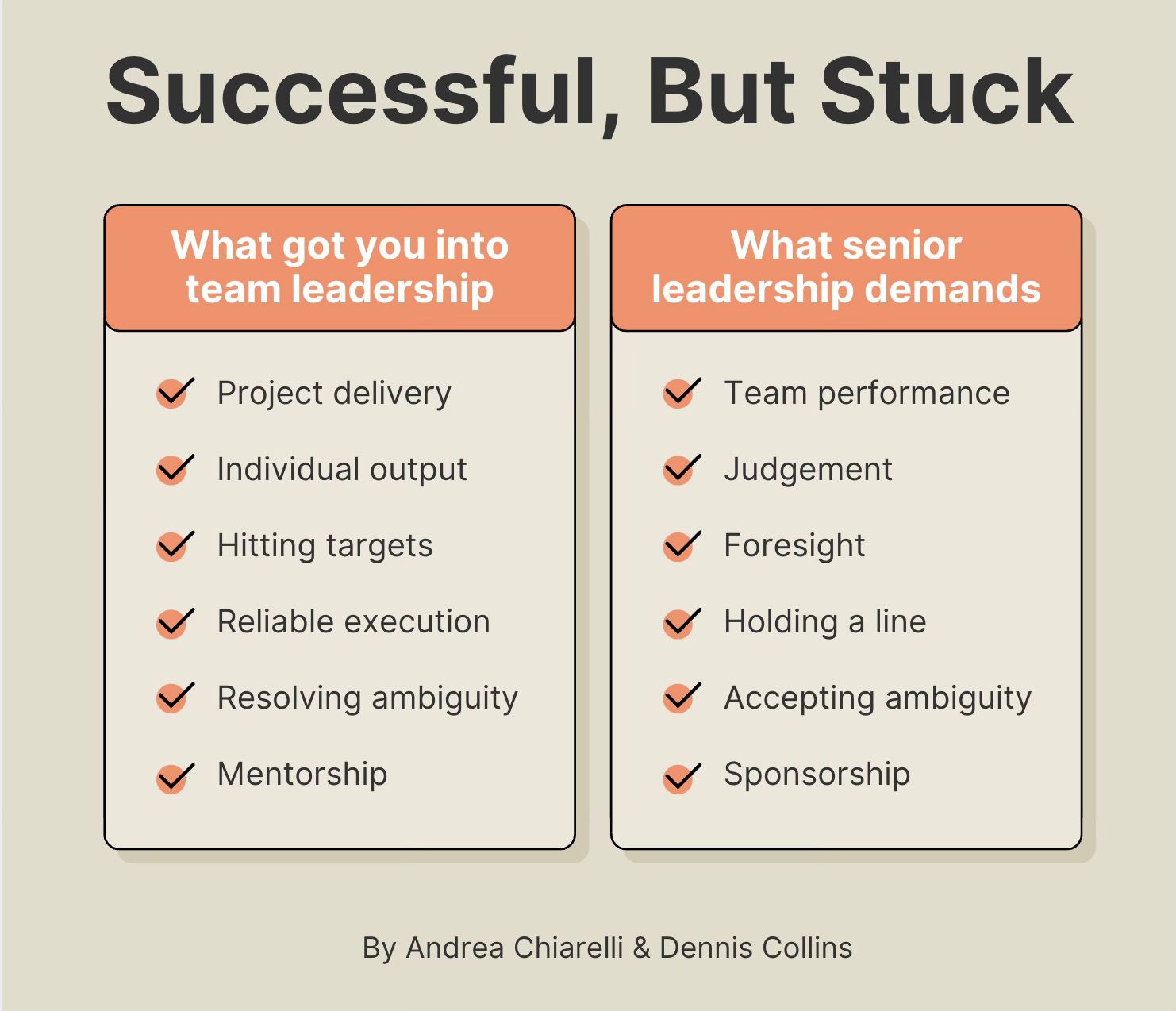
Strong delivery is the entry ticket in leadership roles, not the basis on which decisions are made about who moves up. What gets weighted instead is judgement, and this is harder to evidence because it is projected in subtler ways than a deliverable landing on time.
Senior leaders are looking for signs of judgement in how you behave under uncertainty:
whether you saw a problem coming six months before anyone else did;
whether you can hold a coherent line in a meeting where the facts keep changing under you; and
whether you can make a call when the available information is genuinely insufficient and accept that you might be wrong.
These are different muscles from the ones that got you here. A capable operator who can reliably ship a complex project is not necessarily someone who can sit in a meeting where the strategy is unclear and the answer has to emerge from the conversation rather than be prepared in advance. The shift catches a lot of people out, because the things they were rewarded for earlier (clarity, control, reliable execution) are not the things being tested now. In some cases they actively get in the way, because the instinct to resolve ambiguity quickly can look, from above, like an unwillingness to sit with it.
These capabilities develop through deliberate exposure to situations that demand them, which is where sponsorship comes in. The distinction between a mentor and a sponsor is worth clarifying: a mentor gives you advice, while a sponsor advocates for you when you’re not around and puts you in situations where the next set of capabilities can actually develop. Plenty of accomplished people have mentors and no sponsors, and wonder why they’re not moving.
The catch is that sponsorship depends on a senior person seeing something in you worth spending political capital on. If the signals you are sending are off, the sponsorship tends not to materialise in the first place.
Your team stalls before you do
A key signal you send, by some distance, is the state of your team.
Past a certain level of seniority, you stop being judged on your own output and start being judged on what your team produces and how it carries itself. A senior leader two levels up isn’t watching how you run a meeting; they’re noticing whether your people show up to other meetings prepared; whether your function gets pulled in early on important questions or late as an afterthought; and whether decisions that originate with your team tend to hold up over time. A leader who has lost traction with their team rarely realises how visible that is from a higher vantage point, and the signal reaches senior people long before they know it’s been sent.
By the time promotions stop, something has usually been going on inside your team for a while that registers as a signal to the people above you, even if neither you nor they could pinpoint it.
From the inside, the experience is quite specific: you know you’re communicating properly, you can hear yourself doing it, and yet the team isn’t moving the way it used to.
None of this is necessarily your fault. Teams flatten for all sorts of reasons that have little to do with the person leading them. But the response is yours regardless, because you are the variable in the system that can actually move.
A few things tend to be in play, and they usually overlap rather than appear cleanly one at a time. The team often shifts underneath you without any single dramatic event: people who carried the energy leave, newer joiners haven’t been properly brought into how things actually work, and you carry on leading the way you always have without registering that the group is no longer the same group. Sitting alongside that is the harder-to-see problem of your own style hardening over time. What began as a recognisable approach becomes a default, and you gradually stop reading the room because, for years, the room read you. The most uncomfortable version of all this is that the role itself has changed as you became more senior: what the team now needs from you is less task direction and more help with ambiguity and meaning. If nobody tells you the requirements have moved (and you don’t notice), you will carry on delivering the old version with full confidence while the team goes silent around you.
These shifts don’t announce themselves. Meetings still happen, and on paper nothing is wrong. What disappears is the forward pull that used to propel your career.
The Art of Asking Questions is a reader-supported publication. To support my work, please consider becoming a paid subscriber.
Five things you can do to get unstuck
1️⃣ Start with your immediate colleagues. When you’re stuck, the instinct is to look outward, but the most useful diagnosis usually sits one step closer. If something has gone flat between you and your team, that’s where the work begins, because everything else you might try rests on getting that part right first.
2️⃣ Test whether the structure above you is actually the problem. For example, you could check how many roles have opened up at the level above in the last two years, or whether anyone has been promoted internally rather than hired in. If upward movement is genuinely blocked, continuing to push internally is mostly a way of feeling busy. Recognising that is uncomfortable but useful, because it frees you to put your energy somewhere it can make a difference.
3️⃣ Seriously explore sponsorship. You can’t ask for it directly and you can’t shortcut it, but you can put yourself within range of it: aligning your work with what a senior leader is trying to achieve, making their life easier in concrete ways, becoming someone whose name comes up in good contexts more than once. It’s a slow accumulation of credibility rather than a campaign.
4️⃣ Close a few specific gaps: exposure to P&L responsibility, board-level communication, and external visibility are conspicuously absent on the CVs of people who keep getting stuck just below the next rung. These are not things you can pick up in a quarter, so it helps to plan on an 18–24 month horizon rather than a few weeks. Here’s an example:
I (Andrea) started volunteering as a school governor years ago to gain governance experience - first as a committee member and then as the vice-chair. This later helped me demonstrate my senior-level expertise and credibility, and land positions in an advisory board and a board of directors.
5️⃣ Re-examine what you actually want. After enough years, your title and status start to shape what you’re willing to consider, and moves that might genuinely help begin to feel as though they don’t fit the story you’ve been telling about yourself (check out Claire Alvis’s article on this subject!). A smaller company where your experience is rarer, a different sector where it carries more weight, an adjacent function with a thinner supply of senior people: these often look sideways or even backwards on paper, and turn out to be the most generative thing someone does in a decade.
Check out this article Claire Barrett and I wrote on engaging senior leaders. 👇

The bigger picture
Advancement in leadership roles is contextual. Good performance on its own doesn’t translate cleanly into progression, and sponsorship, visibility, and positioning matter just as much.
Most leaders who get stuck stay stuck because they’re waiting for the system to change around them.
The ones who move tend to make the kinds of unconventional, slightly uncomfortable shifts described above, rather than waiting for the conventional path to open for them. There’s a big difference in agency between these two scenarios.
If you’re sitting in the ‘successful but stuck’ zone, the question worth asking is whether you understand what you’re actually being evaluated on now. The criteria have shifted, and continuing to optimise for the old ones is what keeps the pattern in place.
Understanding that is most of the work. The rest is being willing to act on it.
Enjoyed this piece? Become a paid member and get my Consulting with AI prompt library, the full Asking Questions Like a Pro course ($199 standalone), practical templates from a decade of fieldwork, and discounts on many other resources. 🔗 See everything included in the paid tier.


