
Trapped In Your Business
Why so many small businesses end up running their owners

When consultants are called into an organisation, they are usually given a problem that someone has already picked for them: cash is tight; the marketing isn’t working; the retention numbers are dropping. That framing is shaped by how problems present themselves day to day. A vendor calls about an overdue invoice. A senior employee gives notice. Each event arrives with its own face and its own apparent cause, and it is easy to end up addressing each one directly, simply because that is the form in which the trouble shows up.
Peter S. Bergeron’s book, The Trapped Operator, is built on the conviction that this framing is, almost without exception, wrong. It argues that the named problem is not the problem, but a signal. So, until you are asking questions about the architecture beneath the signal, you are just responding to the noise that an underlying condition is making.
The business has changed, but the fixes haven’t
Bergeron observes that if we treat each problem as a discrete event we end up addressing the same problem repeatedly, in slightly different disguises. A cash crunch is solved with a new line of credit. Several months later, the same crunch returns, this time magnified by the debt accumulated from the last one.
The diagnostic alternative he advocates is to stop asking “What caused this?” and start asking “Which underlying system is failing to contain the pressure that is producing this?” The two questions sound similar, but they produce entirely different conversations. The first looks for an event. The second looks for an architecture.
However, the reason the same problems return is not always that the underlying condition was never addressed: the business itself might have changed, too. In practice, Bergeron rejects the traditional lifecycle framing of startup, growth, maturity, decline, and replaces it with what he calls operational states: survival, scale, and stability.
A business doesn’t move through these in sequence and exit them in a linear way. These are parts of a cycle, and a business can go back and forth across its history: a mature company hit by a new competitor can be back in survival conditions within twelve months; a stable firm that launches a new product line re-enters the scaling problems it had left behind.
The fixes that worked at one point were built for the structure and pressure of a particular state. When the business shifts and starts carrying a different kind of load, those fixes stop holding, because the architecture they were designed for is no longer in place.
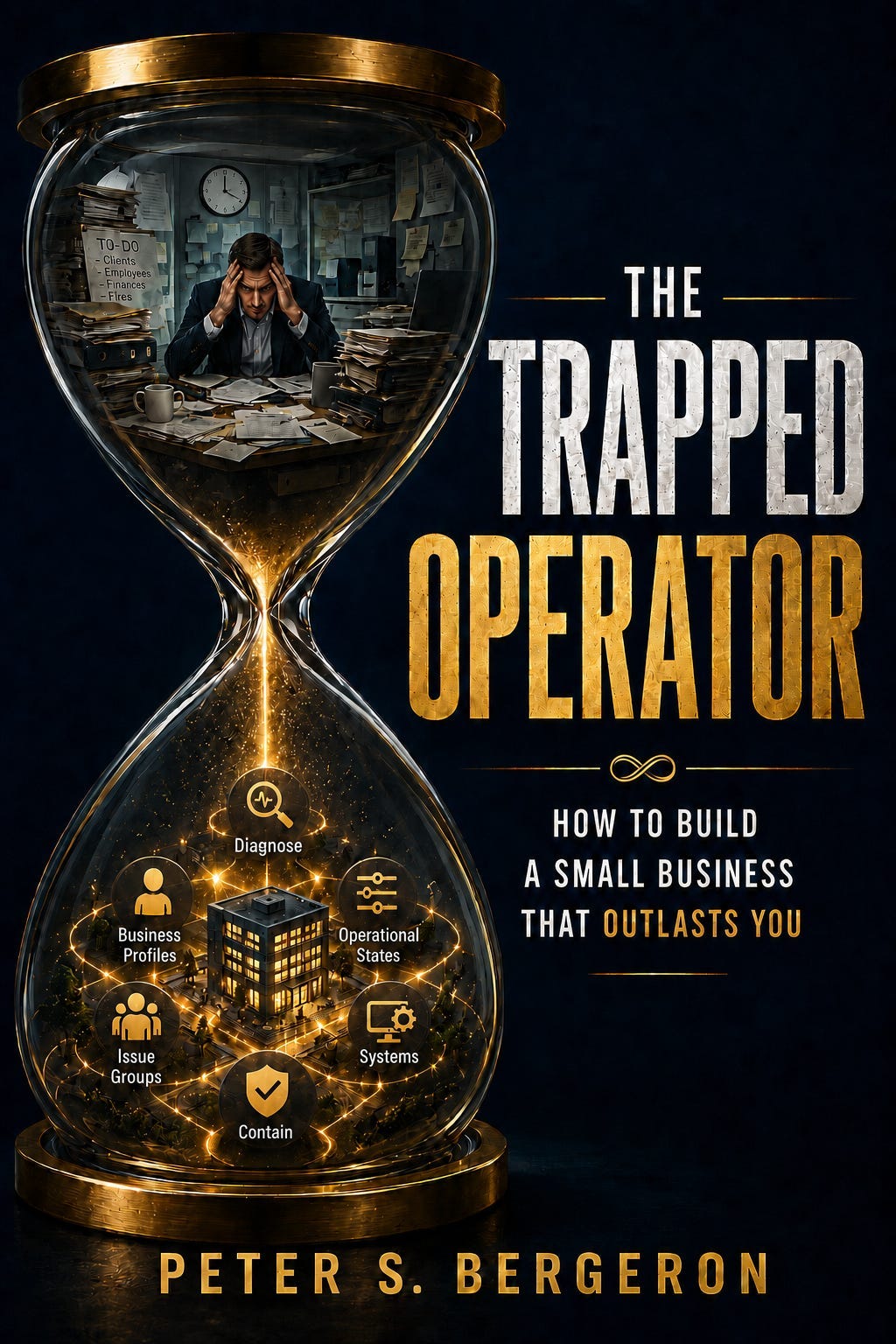
You can find out more about The Trapped Operator and the 12 Fatal Issues here.
The vocabulary problem
Seeing that the same problems keep returning is one thing. Describing what is actually wrong with the business is harder, and most people cannot do it until they find the right vocabulary.
They know something is off and feel the weight of it, but they might have been treating each instance as a personal failing rather than as a data point in a pattern. That interpretation makes the conditions impossible to talk about cleanly.
When Bergeron names 12 recurring issues — inadequate capitalisation, client overdependence, ineffective marketing, ineffective management, and more — he reports that business owners find their own situation in the list within minutes. The relief on their faces, he writes, comes from the realisation that what they have been carrying alone is in fact a documented condition that other businesses have navigated.
The methodological warning here is that the line between giving someone the vocabulary they need and putting words in their mouth is not always obvious. In my own consulting work, I see this all the time: participants who light up when you offer them a phrase, and others who simply agree with whatever framing you bring. Telling the two apart is most of the craft. Bergeron’s framework manages it by being descriptive rather than evaluative, and by leaving people to recognise themselves in the description rather than being told where they belong.
The Art of Asking Questions is a reader-supported publication. To support my work, please consider becoming a paid subscriber.
Six questions to rule them all
I hope J.R.R. Tolkien will forgive me for turning his poem into a business lesson, but this is very much the argument that Bergeron makes in his book: six questions are enough to point you towards the specific conditions that determine whether a small business is stuck.
And the questions, which are meant to be rated on a scale of agreement (1-5), are deceptively plain. For example:
A sudden 50% drop in revenue for one month would not materially change how we operate.
The business continues to perform and adapt effectively when I step away from day-to-day decisions.
Each question is doing structural work, trying to surface where the business is most likely to break rather than what is currently noisiest. Together, they map the load-bearing points of the organisation. And, once these have been identified, the question becomes what to do about them.
Interestingly, most of the advice that businesses receive — and most of the advice that consultants are paid to give — is built around problem elimination. Bergeron argues that this is the wrong frame, because organisations always contain weaknesses, and the more appropriate question is whether the surrounding systems are strong enough to absorb the stress those weaknesses produce.
A business with a thin marketing function can run for years if its customer service and word-of-mouth are strong enough to compensate. A business with weak financial controls can survive if its margins are generous enough to mask the inefficiency. So the point is not whether each function is strong in isolation, but whether the whole architecture can take the strain.
This has two implications:
The first is that triaging by visible severity tends to misallocate effort, because the most visible problem is often the one that has just exceeded its containment, not the one that is structurally most dangerous. Personally, I have seen large and mature organisations, too, address issues based on visible severity — and routinely advise my clients that the most frequent complaints we hear in a consultation are not necessarily the most significant.
The second implication is that recommending the elimination of a weakness without strengthening the surrounding systems can leave the organisation worse off, because the workarounds that were absorbing the weakness might get dismantled along with it.
The question that cannot be asked from inside
Bergeron draws a careful distinction between operating a business and owning one. Operating means the business cannot function without your daily presence. Owning means it can. Most founders, by his account, set out intending to own and end up operating, without ever quite noticing the moment the transition stopped happening.
The test he proposes is simple to state: Could the organisation survive a sustained absence of its founder? Could the decisions, the relationships, the institutional knowledge and the directional judgement be carried by anyone else?
Founders struggle to answer this honestly because their own indispensability is the water they swim in. It is easy to mistake the workarounds they perform every day (the calls they take, the approvals they grant, the relationships they maintain personally) for ordinary management rather than for the substitute structure they have become.
It is common, in cases like these, for a founder to describe the business in operational terms while the staff describe it in personal-dependency terms. The gap between those two descriptions is the diagnostic finding, and it is often the founder, not the staff, who is surprised by it.
Enjoyed this piece? Become a paid member and get my Consulting with AI prompt library, the full Asking Questions Like a Pro course ($199 standalone), practical templates from a decade of fieldwork, and discounts on many other resources. 🔗 See everything included in the paid tier.